Eight years ago, we started Digital Sparrow from scratch.
No investor backing. No fancy office. Just a clear belief that technology — if explained and used the right way — could genuinely change how businesses grow. We built it slow, made mistakes, figured things out the hard way, and eventually got to a place where we know exactly what separates the businesses that make it from the ones that don’t.
And one of the biggest patterns we have seen, especially with early-stage startups, is this — founders are incredible at building products. But most of them have absolutely no idea how to talk about what they built. Or who it is actually for.
So today, let’s talk about that. Because if you just raised seed funding, or you are about to, this is the most important thing you need to get right before anything else.
The Honest Reality of a Seed-Stage Startup
You did the hard part. You built something real. You convinced investors to believe in you. That is genuinely not easy, and you should be proud of it.
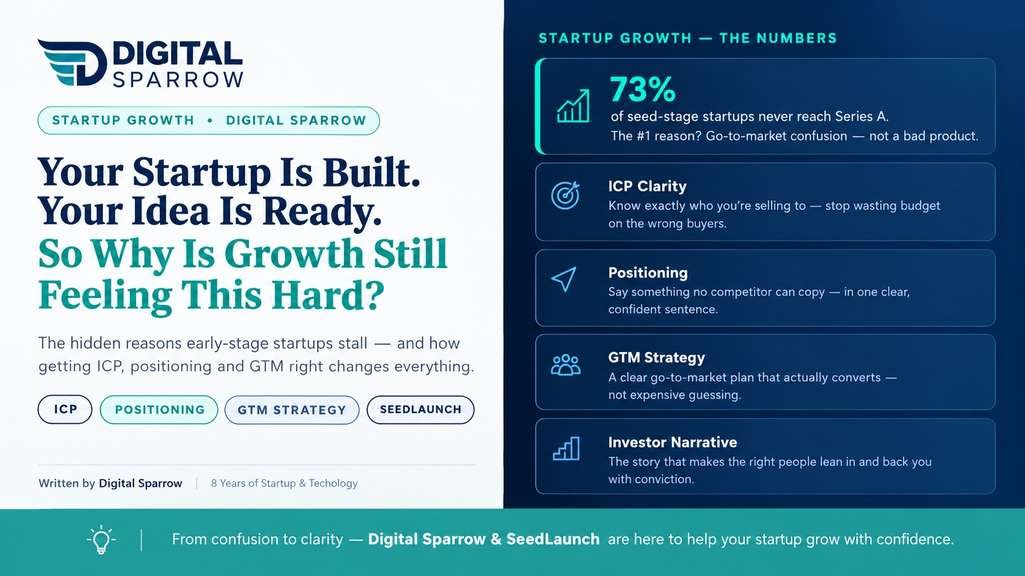
But here is what nobody warns you about clearly enough — raising money is actually just the starting gun. The real race begins after. And the #1 reason seed-stage startups never reach Series A is not a bad product. It is go-to-market confusion.
Think about that for a second. Seventy-three percent of seed startups fail to reach Series A. And the leading cause is not the product. It is that founders cannot clearly answer three questions:
- Who exactly is this for?
- Why should they choose us over everyone else?
- What story makes an investor lean in and write a cheque?
If you cannot answer those three questions clearly, confidently, and consistently — across your website, your pitch deck, your sales calls, your social media, and every email you send — you are already bleeding without knowing it.
What Is an ICP — And Why Getting It Wrong Is Expensive
ICP stands for Ideal Customer Profile. And “SMBs” is not one. “E-commerce businesses” is not one. “Companies that need our software” is definitely not one.
A real ICP is specific. It names the exact type of company, the exact role of the person who feels the pain, what triggers them to go looking for a solution, and what success looks like for them after they buy. It is not a demographic. It is a human being with a specific problem at a specific moment in their journey.
Here is why getting this wrong is so expensive for seed-stage companies: when your ICP is fuzzy, every other decision downstream breaks.
Your sales team pitches to the wrong people. Your marketing budget goes to audiences who will never convert. Your homepage tries to speak to everyone — and ends up speaking to no one. Your product roadmap gets pulled in ten directions by customers who were never the right fit to begin with.
The founders who nail ICP early move faster, close better deals, waste less money, and have a much clearer story when it comes time to raise their Series A.
Positioning — The Thing That Makes You Unforgettable (or Forgettable)
Here is a quick test. Go to your website right now. Read the first sentence on your homepage. Then go to your three closest competitors and read theirs.
If you could swap any of them and no one would notice — you have a positioning problem.
Positioning is not your tagline. It is not your “About Us” page. It is the answer to the question: “Why should I choose you specifically, and not any of the other options available to me?”
The brutal truth is that most seed-stage founders write their positioning based on features — what their product does. But your customers do not buy features. They buy outcomes. They buy relief from a specific pain. They buy a better version of their professional life.
Great positioning makes the right customer feel immediately seen. It makes them think — “This is exactly what I have been looking for.”
Weak positioning makes investors and customers alike nod politely and move on. They heard you. They just didn’t feel anything.
GTM Strategy — The Engine That Runs on Everything Above
GTM stands for Go-To-Market. And it is essentially your plan for how you are going to reach your ICP, deliver your positioning to them, and convert them into paying customers.
Here is the thing about GTM that a lot of early founders discover too late: a GTM strategy without a clear ICP and strong positioning is just expensive guessing.
You run ads — but to whom? You write content — but saying what? You do outbound — but with what message? You go to conferences — but talking to which people?
Without the foundation of a clear ICP and compelling positioning, every GTM channel feels random. You spend. You test. You hope. And pipeline stays thin.
But when the foundation is solid? Everything clicks. Your ad copy writes itself because you know exactly what your ICP cares about. Your outbound messages get replies because they speak directly to a real pain. Your sales calls shorten because you are talking to the right people with the right message. Your pipeline fills up.
GTM is the engine. But ICP and positioning are the fuel.
What About Investors?
Here is something we have observed closely over eight years of working with startups and businesses at every stage — investors do not just fund products. They fund conviction.
When a founder walks into a room — or onto a Zoom call — and can clearly articulate who their product is for, why those specific people have this specific problem, why this company is uniquely positioned to solve it, and exactly how they plan to scale — investors lean in. That is a Series A story.
When a founder walks in with a great product but a fuzzy market, inconsistent messaging, and a story that changes slightly every time it gets told — investors pass. Not because the product is bad. Because the clarity is not there yet.
Narrative is not a nice-to-have for raising. It is the raise.
This Is Exactly Why We Built SeedLaunch
After eight years at Digital Sparrow, watching startups struggle with the same problems over and over again — fuzzy ICP, broken positioning, GTM that goes nowhere — we stopped just observing and decided to do something about it.
We built SeedLaunch — a focused startup born directly out of everything we have learned at Digital Sparrow — specifically to help early-stage founders solve these exact problems. Not with vague advice. Not with a generic course. But with a structured, three-week process that takes a founder from confused and scattered to completely clear on who they are for, what makes them different, and how to tell that story everywhere it matters.
Here is what SeedLaunch actually delivers for you:
- A tight, specific ICP Card — one page that defines your exact buyer, their pain, and what triggers them to act
- A Positioning Statement that is differentiated, defensible, and says in one sentence what no competitor can copy
- A Brand Manifesto — your point of view as a founder, the belief that attracts the right customers and naturally repels the wrong ones
- A GTM Narrative Document — the master story that powers your homepage, your pitch deck, your sales calls, and every piece of outbound you send
- A Homepage Copy Brief and an Investor Pitch Narrative that makes the right people lean in
We built this because the gap was real and we had the experience to fill it. Eight years of watching technology businesses grow — and watching early-stage startups stumble on the same foundational mistakes — gave us a very clear picture of exactly what was missing.
If any of what we described in this post resonated with you, visit SeedLaunch and see how we can help.
You can start with a free 30-minute clarity call. No pressure. Just an honest conversation about where your positioning stands right now and what the next step looks like.
What Digital Sparrow Can Help You With
At Digital Sparrow, we have spent eight years helping businesses — from solo founders to established companies — understand and use technology to grow. Part of what we do is help businesses build their AI stack, their digital presence, and their systems in a way that actually supports growth instead of just adding noise.
If you are a seed-stage startup trying to figure out how AI tools fit into your operations — whether that is automating customer communication, building your content engine, or using AI to support your sales and marketing — we are here for exactly that conversation.
Because the founders who get their positioning right and then layer smart AI and technology on top of it? They are the ones we keep seeing pull ahead.
Have questions about how to set up your startup’s digital and AI stack? Reach out to Digital Sparrow — we have been in this space for eight years and we love talking to founders who are building something real.