Leads are not admissions. See where your university admissions funnel leaks, why cost per enrolment beats cost per lead, and how to grow enrolments.
Leads Are Not Admissions: How to Fix Your University Admissions Funnel
A university can generate 20,000 leads in one admission cycle and still miss its enrolment target. The reason is simple: a lead is only the first step of a long journey, and every stage after it loses students. To grow admissions, universities need to measure and improve the full university admissions funnel, not just the number of leads at the top. This guide explains where students drop off, what to measure instead of lead volume, and how to shift marketing towards confirmed enrolments.
The Real Admissions Funnel Has Six Stages
Many marketing reports describe the journey as Ad → Lead. The real path is longer:
Ad → Enquiry → Qualified Student → Application → Offer → Enrolment
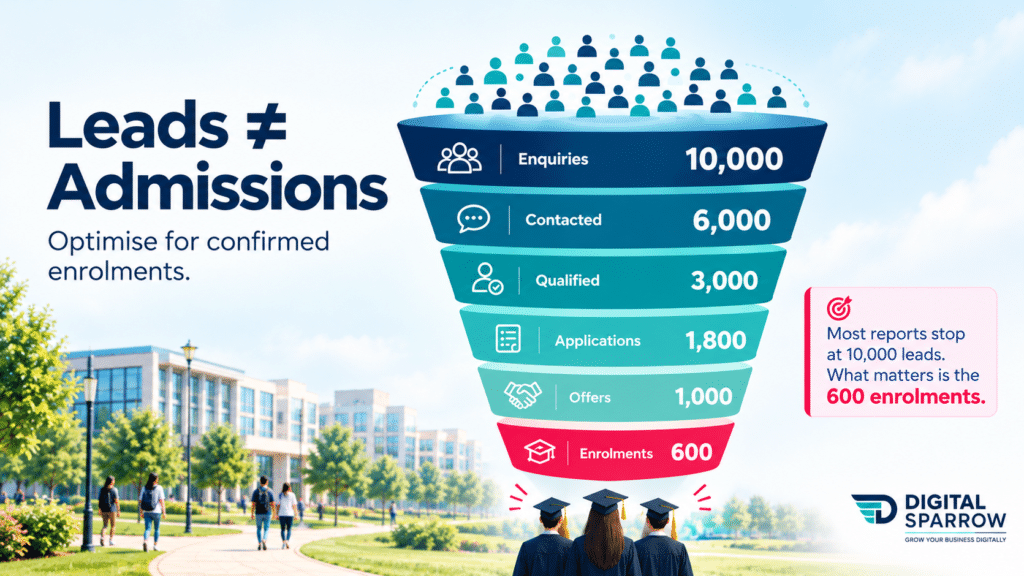
Here is an illustrative example, not client data:
- 10,000 enquiries
- 6,000 contacted
- 3,000 qualified students
- 1,800 applications
- 1,000 offers
- 600 confirmed enrolments
In this example, only 6 per cent of enquiries become enrolments. Raw lead counts also include duplicates and incomplete forms, which is how 20,000 leads can shrink to 10,000 genuine enquiries before the funnel even begins.
Where Students Leak Out of the University Admissions Funnel
Each stage has its own typical causes of loss, so each needs a different fix.
- Enquiry to contact: slow response or missing phone numbers
- Contact to qualified: poor targeting that attracts students who do not meet eligibility or budget
- Qualified to application: unclear course information and complicated forms
- Offer to enrolment: fee concerns, scholarship questions, or competing offers
These causes are common patterns, not findings from a specific university.
Why Most Reports Stop at the Wrong Number
Most marketing reports end at lead volume, cost per lead (CPL), and click-through rate. These numbers are easy to collect, but admissions leadership is accountable for something else: confirmed enrolments and fee payments.
When a report stops at 10,000 leads, nobody sees that 4,000 enquiries were never contacted, or that half of the contacted students were not a fit for the programme. These are the stages where budget quietly disappears.
The Cheapest Lead Is Not the Most Valuable Student
Consider two illustrative lead sources with equal ad spend. Source A delivers 1,000 leads and 5 enrolments. Source B delivers 400 leads and 12 enrolments. Source A looks cheaper per lead, but Source B costs far less per enrolment. A report that ranks sources by cost per lead would choose the wrong winner.
This is why cost per enrolment, meaning total marketing spend divided by confirmed enrolments, is a more honest measure than cost per lead.
How to Optimise Your University Admissions Funnel for Confirmed Enrolments
Track each stage separately, then fix the biggest leak first.
- Measure stage-to-stage conversion. Record how many students move from enquiry to contacted, qualified, applied, offered, and enrolled.
- Respond quickly. Slow first contact can push students towards competing universities. Automated follow-up through WhatsApp, email, and chatbots helps counsellors reach enquiries sooner.
- Qualify early. Capture course interest, eligibility, and budget in the form or first call, so counsellors focus on right-fit students.
- Connect your CRM. A customer relationship management (CRM) system linked to ad platforms lets you judge campaigns by enrolments, not leads.
- Support the final stages. Application reminders, document checklists, and clear fee information reduce drop-off between offer and payment.
Digital Sparrow’s services cover lead generation, email and WhatsApp marketing, and AI chatbots with automated lead qualification, all of which map to these stages. For an example of the company’s education work, read its published case study on online maths and science teaching businesses.
Optimise for Enrolments, Not Leads
Leads matter, but they are only the starting point. Universities that measure every stage of the university admissions funnel, respond fast, and judge campaigns by cost per enrolment make better decisions than those that chase the cheapest lead. Better students and stronger cohorts come from a funnel that is managed end to end.
At Digital Sparrow, we are building around one belief: do not optimise for leads; optimise for confirmed enrolments. To find out where your university admissions funnel leaks, contact Digital Sparrow for a consultation.
#Higher Education Marketing #Admissions Marketing #Education Marketing #Digital Marketing #AI Education